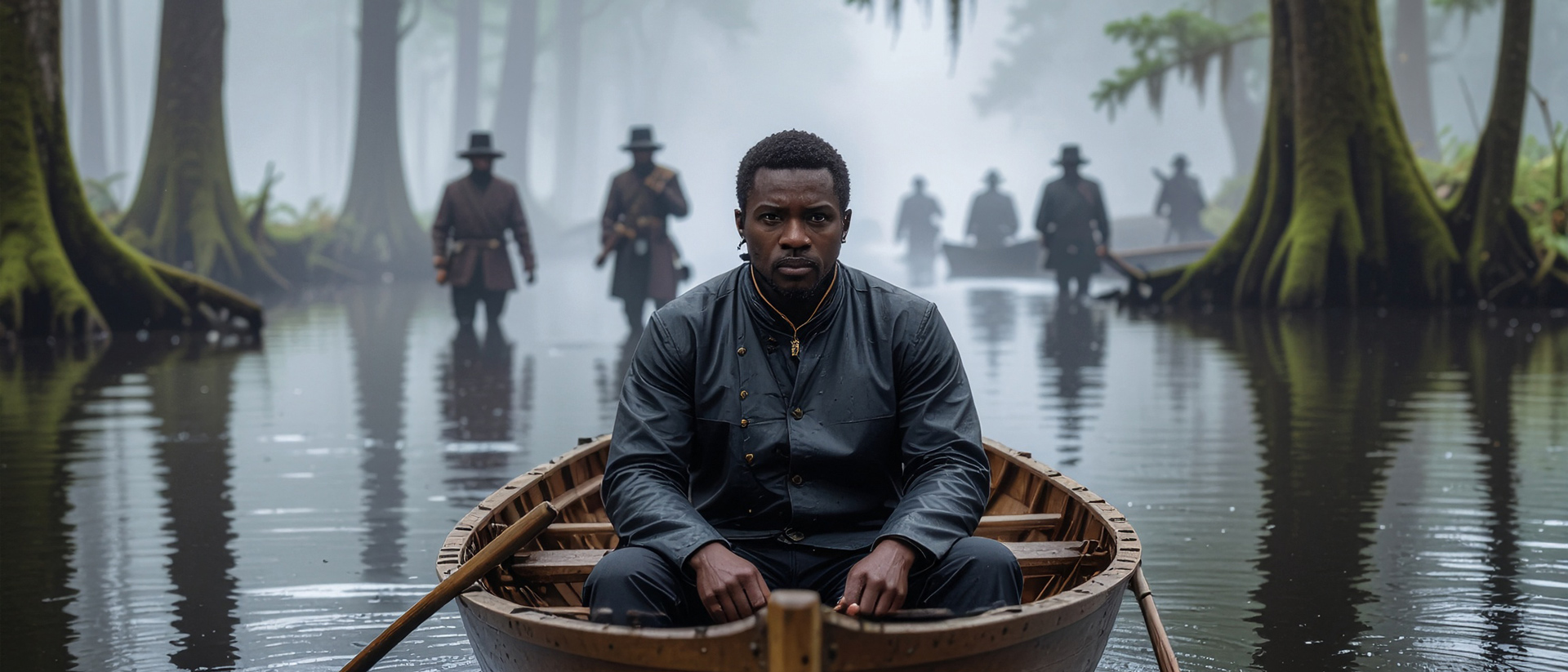
Prologue — Water, Work, and the Maroon Way (History & Belief)
Maroons” were people who liberated themselves from slavery and fashioned new, often mobile communities beyond the state’s easy reach. In Louisiana, their geography was water: cypress–tupelo swamp, freshwater marsh, and the thin ridges locals called the Bas du Fleuve. Where planters saw hazard, maroons saw corridor. A pirogue could slide where a patrol’s skiff stuck; a ridge two feet higher than the marsh could hold a garden, a fire, and a night of safety. Marronage here ranged from short absences (petit marronage) to longer settlement. Camps fished, trapped, cut timber, and quietly traded mats, fish, and labor for needles, nails, salt, or cloth through the city’s back door markets. Indigenous knowledges of the wetlands braided with African memory and the vernacular skill of people who had learned to survive scarcity and surveillance. Leadership was situational—who knew the route, who could broker a trade, who could hold a circle together when fear ran hot. The name Jean (Juan) St. Maló marks one such circle in the 1780s; his capture and execution in 1784 turned a life into a public lesson—and into a song that refused the state’s version of the story. If maroons had a “belief,” it was less a doctrine than a grammar of freedom:
• Freedom as practice: not a proclamation but repeatable work—mending nets, reading wind, setting traps, plaiting roofs.
• Quiet law: rules made by and for the vulnerable—no names shouted over water; never answer an unknown voice; never create a pattern a patrol can learn; patterns are nets.
>• Mutual care as politics: rations shared; wounds treated with plants and experience; discipline aimed at survival more than punishment.
• Ancestral regard: speaking with the dead at the water’s edge; tucking offerings—tobacco, fish, song—into the world that had sheltered them.
• Knowledge as commons: routes, tides, bird language, star positions—taught to children so memory could outlast paper.
Violence existed—raids for tools or food, armed defense when cornered—but power mostly lived in invisibility and in neighbors who chose one another, again and again, in a place designed to erase them. This written documentary enters a camp on the marsh’s shoulder, attends to its ordinary genius, and follows it through a tightening net to the city’s theater—so that the last thing remembered is not the scaffold, but the love of freedom that built a life at the waterline.
A Love That Chose the Marsh — A Story of the Bas du Fleuve (c.1783–1784)
For the maroons who made freedom a daily craft, and for those who kept it alive in song.
I. Morning on the Ridge
At first light the marsh looks like pewter hammered thin. A heron lifts from a cypress knee and the water, which has been whispering all night, pauses as if to listen for its own name. On a small natural levee two handspans higher than the surrounding grass, a camp breathes itself awake.
Cecilia is first to the fire. She palms away ash and coaxes orange out of last night’s coals with a breath that trembles from cold and from the habit of quiet. Her hair is plaited tight and practical, a seed packet hidden in one braid, a fine needle in another. She checks the palmetto roof for leaks—two places to mend—and sweeps a palm across the packed earth floor, reading the grit with her skin like a map. “Maman?” Baptiste asks, still inside sleep.
“Hush, ti-zozo,” she says, little bird, and pulls him into the crook of her arm. He is five and has the run of the ridge under supervision, which is to say he thinks he knows every bird and every cutting reed by name. Today he will learn another lesson: how to listen for a patrol before the patrol knows it means to come.
On the ridge, life takes the shape of need. A pot comes to a simmer—thin cornmeal brightened with a pinch of salt that cost two palmetto mats and a promise. Fish are sorted: catfish from the reed traps, three perch, a soft-shelled turtle in a woven basket kept half in the water so it stays calm. Okra in a row grows like a line of small green candles. Tobacco bends like handwriting. Someone has tucked a sprig of mint in a clay lip for luck and for the baby’s colic later if it rises.
The camp is not large. Four dwellings hunker under palmetto thatch. A lean-to shades tools: two hoes, one with a handle that is more repair than original; a small axe; a pair of files wrapped in cloth; a knife so thin it looks like a sliver of moon. Nets hang from a horizontal pole to dry, patched with twine spun from moss and sinew. This is not a fortress. It is a way of being: quiet, mended, watchful.
Across the water, just beyond a tongue of cane, St. Maló pushes a pirogue with a pole and tests the height of night by the chill in his teeth. He is older than the boys who paddle with him and younger than the stories that have already begun attaching to his name. He has a face that you would not pick out of a crowd, which is a kind of safety. His hands are work: scars mapped in thin white lines, callus where the pole bites, soft at the webbing because a man who grips too hard fights his boat and loses.
“Wind’s about to turn,” he murmurs. The boys—Nico and Paul—nod. They have learned to answer with their bodies: a shift of weight to keep the pirogue level, a widening of eyes toward a cut they intend to take, a smile so small it is more like a thought becoming a smile.
Maló’s pirogue noses in at the ridge. Cecilia lifts two fingers in greeting, neither indulgent nor deferential, a line of respect between equals. He sets down a bundle: a fist of nails, two needles, a bit of iron hoop cut from a barrel—treasures so ordinary in town they vanish into the street, treasures here that bloom into tools. He lays a hand on Baptiste’s head and moves it away before the boy can twist free with embarrassment. “You’ll take the reedline today,” Cecilia says. “The fish like the angle of moon better on that side this week.”
“And you’ll take rest?” he answers, all mock gravitas.
She huffs, and the sound is a laugh that remembers how to be a laugh. “When the marsh rests.”
Behind them, Maman Sidoine wakes with the controlled groan of old wood. She stretches until bones speak, then ties a cloth around her head that once belonged to a woman whose name none of them will say aloud this morning. Names have a way of crossing water when you are careless with them. Sidoine speaks a prayer half under her breath, not to the men in town’s God who cannot seem to hear across cane, but to the mothers who used to sit where she sits and the children who survived their crossing by forgetting and then remembering at once.
“Eat,” she says to Baptiste.
“Grow quiet and strong.” When she says quiet, she means careful. When she says strong, she means the kind of slow endurance that outlasts weather and men with guns who cannot read marsh grammar.
The morning unfolds. Nets into the water. Poles cut and trimmed. A basket fills with palmetto strips. Cecilia sets Baptiste to practice: he does not call the heron’s name until the heron calls his. He does not step where the grass lies down in one direction but where it lies down in two; the first may mark a hog trail, the second a wind that will tell him which reed bed breathes under its own power. Every lesson is a way out of some future trouble. By midmorning the sun has smeared itself across the sky and the marsh smells like hot copper. A ripple touches the camp’s surface—a sense more than a sight. Cecilia stiffens. Sidoine’s eyes slip toward the cane without moving. Maló, already on the water again, lifts his pole, lets it kiss the bottom, then holds it there. Silence spreads like oil. Even Baptiste feels the weight of it and tucks his questions behind his teeth. Then the ripple resolves into a heron and a breath goes out the way a prayer goes out when the person you love finally answers the door after a night you learned new kinds of patience. The day relaxes by half. Half is enough.
II. The Back Door of a City
New Orleans pretends to be a city of front doors: river, levee, lines of ships and men counting things that have never belonged to them. But the true entrance lies behind, where canals and back-of-town lanes stitch a seam between law and things that live with or without it.
Armand keeps a shop in that seam—a half-open place that smells like sap and smoke, the kind of place where a missing board is not missing but a way to keep air moving without calling it a window. “Assez?” he asks, weighing a palmetto mat in his hands. Enough? His voice carries the city’s part-French, part-something-else music. He is a free carpenter; the papers in his pocket say so and do not change the way patrols watch him the week after a governor signs a new proclamation. But he has something more durable than paper: neighbors who remember a roof repaired when rain came through, a table made for a widow. Reputation turns away certain kinds of trouble. Cecilia nods. “Assez. And for this one—” She lifts another mat, tighter woven, edges finished with a stitch that keeps palmetto from fraying when it wants to unravel into strips the way a person wants to unravel into sleep at the end of a long day. “—two needles, a file, and a handful of nails that won’t be missed.”
Armand grins without showing teeth. “Rien n’est manqué quand on sait fermer les yeux.” Nothing is missing when you know how to close your eyes. He slides the tools across, wrapped in a square of cloth that looks like nothing from far away and exactly like something to the eyes that should see it. Money changes hands in a way that leaves no clink. Words change hands that do not look like words.
“Patrols took a new cut last night,” he says, as if remarking on the price of fish.
“Longboat with men who finally learned to listen. They tried silence on like a shirt. Didn’t fit them yet, but it might.”
Cecilia does not nod. Agreement is a sudden movement, and sudden movements live in memory longer than they should. “Merci,” she says, and then, because he has paid for risk with honest warning, she adds, “Tell your little one the story about the fox and the gourd. He asks me for it twice a market day.”
Armand’s laugh is the kind of quiet that makes Baptiste crane his neck to hear. “He likes the part where the fox pretends to drown to make the dog afraid,” Armand says.
“Everyone likes a trick that keeps them alive,” Cecilia answers, and the door-lane breath of the city settles around them the way marsh heat settles around a pirogue that has stopped moving.
They stage exchanges like this often enough to call it habit and not often enough to call it pattern. Pattern is how a patrol finds you. So Cecilia brings mats one day, bundles of dried fish the next. Armand passes a gourd one week with a hidden iron hoop and a pot the week after with nothing but pot. The men who would call this theft are men who have never properly accounted for the bodies that built their houses.
News travels alongside barter. A boy in town has been boasting that he knows a way to the lake where no one else does. He boasts because he wants to be afraid of less. He boasts because he does not yet understand that freedom is sometimes the opposite of telling what you know. Armand says the boy’s uncle tries to shush him, “but loudness sits in some people like a splinter.” Cecilia files that away. Splinters can fester. Splinters can also be pulled.
III. Rule-Making in a Place With No Court
That night the camp meets to talk. A circle forms the way water forms a low place naturally: people find an edge and sit. A lamp burns low, wick trimmed. Children curl into laps, the kind of sleep that takes parent and child both by surprise and gives them back to the world a little less on guard.
Maló opens his hands in front of him, palms up. It is not a gesture of pleading or surrender but of offering: here are the tools we have—knowledge, routes, patience. He clears his throat. Words are not cheap here; they are traded like nails.
“Armand says the militia listens better,” he begins.
“And a boy in town makes a road with his mouth.”
Sidoine nods. “Every song has a part that lets the people sing back. This boy sings that part too early.”
“We could move camp,” says Paul, who is tired of feeling like a fish that has learned every knot in the net and fears the net will change.
“We could,” Maló agrees. “But the people who planted these rows would have to plant new ones. The traps would have to be set again. The children would have to learn the sound of the wind in a different set of reeds. We are not trees, but we grow roots wherever we can. Moving is possible. It is also a cost.”
“What, then?” Cecilia asks. She knows he has been thinking. The way he taps one finger against his knee when he listens is not so different from the way he taps the pole against the bottom of a channel to judge depth. Maló looks at Baptiste, asleep now with his mouth open to the night as if he could eat it like fruit.
“We scatter our work,” he says.
“No single person carries a thing alone. One learns to set traps. Another learns to mend. Another learns the market words that say we have nothing to sell and then sell something anyway. And we do not go to town on the same day twice. We do not go to the same door twice in one week. We swim through patterns without letting them stick.”
Sidoine smiles. “We do what we have always done, then.”
“We do it more,” he says.
“More costs, too,” Cecilia says, not because she resists but because she is the kind of person who counts the weight of a load before she lifts it. “It costs sleep and the extra breath you spend walking the long way around. It costs the ache you keep quiet until it speaks louder than you meant.”
Maló’s mouth softens. “It does. But freedom has always been paid for in those small coins. The big payments—the ones the city makes a theater of—those we do not get to choose. These we do. I choose them.” Cecilia reaches across the circle and touches the ground with her fingertips. It is the gesture of someone stamping a seal on an agreement.
IV. The Lesson of the Reed Bed
The next day Baptiste learns fear. It is not the kind that leaps on a person like a dog. It is the kind that slides under the door and waits in the corner until you notice it without anyone having to say its name. He and Nico take the pirogue along the reedline Cecilia favored. The water there is brown like tea and moves as if unwilling to make up its mind. They set three traps. They talk about nothing that matters—how a cloud looks like a goat, how a different cloud looks like a goat that has not been fed. A dragonfly peels the air in two and stitches it back together with its flight. The boys grin at each other; they are alive in a way that makes their bones feel like bells. Then the reeds make a new sound.
It is not wind. It is not a pig. It is not a bird. It is men who learned to push longboats and who have practiced being quiet until quiet stopped laughing at them.
Nico touches Baptiste’s elbow and Baptiste does not need to be told to be still. Silence follows them like a friend who knows when not to speak. The boys slide the pirogue into a cut so narrow it scrapes both sides. Baptiste counts the scrapes in his head so he will be able to find this place again by number if not by sight.
Voices drift. They are the voices of men who learned to speak low not because they respect the marsh but because they fear embarrassing themselves in front of one another by making a mistake. The voices are in Spanish and French and the kind of wordless grunt that men who pretend to be braver than they are share like bread.
The longboat noses into view beyond the reeds. Baptiste can see a boot. He imagines the foot within it. He imagines the man’s ankle rolling if he steps wrong, the hiss he will make when the marsh sucks his leg to the knee. He imagines the gun, the powder, the way a spark leaps from pan to touchhole.
Nico squeezes his arm once—this is the sign for wait, not the sign for run—and Baptiste breathes the way his mother taught him when the baby’s crying would not let up and he had to be the river of calm that wore the rock of worry smooth. The longboat hesitates. There are three possible channels. The right one is not the one that looks right. You cannot tell this by sight; you have to know it by the way the reeds ask you a question.
The men choose badly. The boat sticks on a hidden shoal. A man swears at a God who has never fished here. In the small thunder of their frustration, the boys slip backward the way light slips off the surface of water when the sun tips behind a cloud.
They do not celebrate. That is part of the lesson. They paddle as if they are afraid to be happy because happiness is loud. When they reach the bend that hides the camp, Nico cannot help it; he grins the grin of someone who survived and wants to spend his survival like a coin.
Baptiste grips the side of the boat so hard it leaves half-moons in his palm. He has learned something heavier than joy: that he can be still enough to not be seen, and that stillness is sometimes a love song to the living.
V. The Splinter
The boy in town keeps boasting. He says he knows a way to the lake. He says a name he should not say, half a name really, the kind that cannot convict anyone by itself but that grows a skin of rumor and walks on its own legs. He does not mean harm. He means to feel large in a room where men throw their words like knives and wait to see who bleeds.
Armand pulls him aside. “Petit, you love your mouth more than it loves you.”
The boy laughs. “Everyone loves my mouth.”
“Not the people who live on the other side of the reeds you’re cutting with it.”
The boy scowls at being made to think about anything but himself. “You always talk like a school,” he says, which is his best insult and not a bad one.
Armand takes a breath that tastes like sawdust. “I talk like a man who likes his neighbors alive.” He flicks the boy’s ear with a finger that could drive a nail flush—just enough pain to write the lesson in skin, not enough to leave a mark someone could call a bruise.
“Plenty of people walk out there,” the boy mutters, rubbing his ear. “Spaniards. Fishermen. Filipinos. Half the town thinks the marsh is theirs by right.”
“Plenty of people drown out there,” Armand says, and leaves him to think or not think as he chooses.
A week later, two men come into Armand’s shop pretending to need a crate repaired. They have the smell of the barracks about them—the kind of sweat that fails to wash off in water and needs laughter to be diluted. They ask after nails. They ask after saws. They ask after men who make things and men who make trouble. Armand measures the crate three times as if the wood can be made honest by the tape itself.
That night he sends word. His word goes out folded into a basket that contains nothing but a carefully mended hole. The basket changes hands twice before it reaches Cecilia. She takes one look at the pattern of the weave—Armand’s tell—and knows the message: Patrols learn. Be wind.
VI. A Feast in a Lean Time
There are days when the marsh gives you more than you asked. A net that should have filled slowly fills at once with a school that got confused by a shadow. A trap set for one turtle returns two. Someone finds a fallen honey tree and, miracle of miracles, does not get stung.
Cecilia decides to call a feast, which is to say she decides that for one evening no one will pretend they are not hungry. She sends Baptiste with a gourd to fetch fresh water from the spring that only runs after rains. She sends Paul to cut cane for skewers. She sends Nico to take a message to the next camp down the ridge, the one with the woman who sings a song that makes the babies stop crying even when they are not hers.
Sidoine sets to chopping. Her knife moves like a thought becoming a habit. Okra, onions, greens, turtle meat, fish. She stirs a pot with a paddle that has been sanded so smooth it reflects a woman’s face in it if the light is right and the water is still.
When evening comes the camp glows like a small secret the marsh cannot keep to itself. People arrive the way slow rain arrives—one by one and all at once. They bring what they can: a handful of salt, a strip of pork traded for a morning’s work, a song. Armand comes late, face closed in the way of a man who has walked too long between two worlds and does not want to bring one into the other.
“Eat,” Cecilia says, pressing a bowl into his hands. “Then talk.”
He eats. He lets the stew tell his mouth a story of smoke and leaf and meat. He feels his shoulders drop the width of a finger. Then he says the thing he has been carrying.
“They mean to make a theater,” he says. “They have been writing paper, and paper wants actors. They have a name they think is a stage big enough to invite the whole town to watch.”
Maló does not ask the name. He can feel the room’s attention tilt toward him and knows that attention is a kind of net as well. He shrugs, almost a joke. “They always need a name,” he says. “Names are easier to tie to a post than routes.”
Armand’s eyes are tired. “Do you love your name?” he asks, plain
.Maló smiles with his mouth and not at all with his eyes. “I love what it lets the children call me.”
The feast continues because hunger continues. They sing because songs are tools. They send the guests back into the cane with extra food tucked into palm-leaf wraps because this is how a people says we expect you to live to see us again.
VII. The Net
The patrols grow patient. They stop making the mistake of always choosing a channel with their eyes instead of their ears. They learn to pole. They learn to hold their breath. They learn to want praise more than they want to go home early.
A man with a scar on his cheek—his name is not recorded anywhere that matters—takes charge of a longboat and makes it his business to understand the way reeds sigh when a boat passes too close. He has never respected a marsh before. He begins to. It makes him angry. He would rather hate the thing he hunts than admire the way it evades him.
The boy in town stops boasting as loudly. It is unclear whether Armand’s flicking, or the weight of the men who came to ask about crates, or the simple maturation of fear taught him. His quiet comes too late to be useful. Paper has already been written. The net is a set of routes and a set of promises and a set of men who want to talk about success near a table filled with drink.
In the Bas du Fleuve, the camp continues because children must eat and gardens do not harvest themselves. They narrow their visits to town. They set decoys—small fires in places no one sleeps, traps they do not bother to check, paths marked with the footprint of a man who does not exist. They turn themselves into rumor on purpose.
But rumor is a porous wall. One dawn, when the water looks like hammered pewter and frogs fall quiet all at once, the scarred man’s longboat slides into a cut that is not on any map drawn by men who only go outdoors to get between buildings. He gestures with his chin to four men to take the right, three to take the left. He keeps the center for himself. He moves as if he believes the marsh owes him an apology and means to collect it.
VIII. The Taking
Maló feels the change before he sees it. The air folds around him differently; the taste of the wind grows a skin of iron. He sets down the push-pole and lets the pirogue drift into reeds as if it were a log that lost its purpose.
He could run.
He has run more than once—run being a word that often means paddle quietly or make your breathing smaller than the sound of a heron lifting or become part of the shadow that the palmettos lay on the water. He could do any of these things now and perhaps he would live to carry a child on his shoulders and listen to a woman he loves tell him he is foolish to lift more than he should.
But the camp has scattered already because he taught them to. The boys know the route that braids two cuts east and one north into a channel no one else trusts. The women know how to vanish into cane and leave no more scent than a night breeze. The old people know how to be still in a way that makes a body look like a stump. If he runs now, the longboat will press deeper—men high with the possibility of catching someone they can name. If he lets the net find him, the net may be satisfied with the weight it thinks it holds.
He makes his choice.
He stands where the brush breaks and the ridge climbs the width of a hand. The scarred man hesitates because the thing he hunted has decided to be the thing that meets him. He composes his face into a version of dignity he practices for superiors. “Juan San Maló,” he says, tasting the authority of his own mouth. “A la orden del gobernador.”
Maló nods as if someone has told him the price of a thing he already meant to buy. He shows his hands. He does not look toward the place where Cecilia watches, small as a reed shadow, face closed and wet. He does not look toward the fireroom where Sidoine has banked coals and is now pressing a hand to the ground as if to slow the earth itself.
They bind him—not roughly, not gently—and walk him through water that rises to the thigh, then the waist, then the chest. A man slips and curses a God who has never eaten from a camp bowl. The sun lifts. The heron pretends not to notice.
Behind them, the ridge remembers his footsteps the way a child remembers a laugh.
IX. The City’s Theater
They mean to make a lesson out of him. That is the point of theater: to let people learn the lines they are expected to say without the cost of thinking about whether the plot makes sense.
In a room with thick air and a window that looks at nothing, a clerk asks questions and scratches answers with a quill that makes the sound of an insect trapped against the wall. Names, routes, who buys fish, who sells nails, who trades words like bread. Maló answers by holding the inside of his mouth against the back of his teeth. The story that will spread says he bit his tongue and let his own blood choke him rather than speak. The story is not precisely true and is precisely right. He did bite down once, so hard it left a mark, to remind himself that flesh can be ruled by a mind that has decided what love requires.
A priest visits with prayers that smell like wax and fear. He is a man who believes in heaven and also in the power of being seen to have visited a prisoner. He says words into a space already crowded with other words. Maló looks at his hands, at the half-moon of dirt under a nail he missed because the water at the pump was cold and the guard was impatient.
Outside, the square builds itself as a stage. Baskets of bread pass. Children climb shoulders. Men who move sugar with their backs stand with their arms crossed, faces closed. Women knot their headwraps tight. The city is good at this. It likes to put its messages where everyone can see them. It imagines that if it raises a scaffold high enough the marsh will feel small.
The morning of June 19, 1784, comes in like any other day in a hot town: with the smell of bread and horses and a kind of excitement that feels like heat but is really appetite looking for a reason. The scarred man has put on a coat as if a garment could make him the person he wishes to be.
They bring Maló out. He is shorter than most of the stories have made him. He does not glow. He does not burn. He looks like a man who worked with his hands and loved a people enough to choose the version of death that leaves them the widest margin of escape.
A hush settles—the kind that falls when a bird breaks cover and all the smaller lives nearby decide not to move. Someone hums three notes of a song that is older than the words they will use to explain it later. A woman—no one will be able to agree which—begins a lament. It is not the one the priest expects. It has a rhythm that knows water.
The thing happens.
The city exhales as if it has done something good for itself. The men who built the scaffold exchange glances that say we will be paid. Children ask questions their parents do not answer because answers are harder to carry than silence. The scarred man stands a little taller and then shrinks a little—these kinds of days do that to a person. The priest goes to lunch.
X. After In the marsh that night, Cecilia sits with Baptiste and teaches him how to tie a knot he already knows, because this is how mothers tell their children that the world continues despite what the world has done. She tells him a story about a fox and a gourd. He laughs at the part where the fox pretends to drown to make the dog afraid. She does not tell him that a man pretended not to fear death so that a camp could live. Sidoine builds a small fire under a pot with nothing in it. She stirs it as if stirring could make something come out of nothing, and perhaps it can, once. She talks to the women who are not there—the ones whose names ride the surface of memory like lilies—asks them for patience, asks them for a sign that the routes are still there and that the boys were not followed, that the decoy fire caught the longboat’s attention as intended. Armand walks to the edge of the lake and lets the black water reflect him small. He thinks of the boy who boasted and of the men who asked after crates and of the tiny weight of those tools in Cecilia’s hands when he slid them across the counter. He is not a man who asks for forgiveness often; the word sticks in his throat. He asks anyway, not because he thinks he is to blame but because he knows he is part of the weave and any broken strand threatens the whole. In the city, a woman hums the lament under her breath as she folds laundry. A child repeats a phrase and makes it mean something new in his mouth. A man sharpens a knife. Rats carry crumbs under doors that once shut out nothing and now shut out less.XI. The Dirge
But something begins. In a back-of-town room where people gather to eat what they can and talk about what they cannot, a woman sings a line that makes the room lift its face as if to drink. Another woman sings it back. A man takes the line and steps it like a dance into a different rhythm and it fits there too. The words do not mention the scaffold. They mention the water and the way it holds a person up if the person remembers not to fight it. The song is a way of refusing to let the city’s theater be the only story. It turns a death back into a life by naming what that life made possible. It lets children carry a man in their heads without having to carry the picture of the rope. It keeps routes alive. It keeps silence from becoming erasure.
XII. The Marsh Remembers
Months later, the ridge holds a garden again. Not the same garden; nothing grows back exactly as it was. But in the new row of okra is the old row’s will. In the child who sets the trap is the boy who learned to breathe small. In the woman who mends the roof is the woman who mended the roof and the woman before her who taught her to plait palmetto until it behaved.
Patrols still come. They will always come as long as there are men who believe their job is to make other people afraid. But fear has a short half-life here. It meets stubbornness and turns into something else: prudence, laughter, a list of rules that are really a list of loves.
Baptiste grows taller. He learns to read the reedline without speaking. He learns to visit town with his head high and his mouth closed. He learns that a knot tied right is a kind of prayer. He learns to miss a man he did not get to know as well as he wanted and to turn that missing into work.
Cecilia’s hands soften slightly in the months when the garden demands less and harden again when the storms come. She does not always sleep through the night. Sometimes she wakes and listens as if the marsh will tell her whether morning will be a good idea. When it does not tell her, she makes morning anyway. That, too, is a freedom.
Armand teaches his son the fox and the gourd and also how to use a saw without losing fingers. He keeps a ledger with no names, only numbers that stand in for people who will always be more than anything he can write. His shop remains a door in the back of the city where air moves, where things that must cross from one world to another can do so without anyone announcing the crossing like a parade.
Sidoine lives to see Baptiste paddle a boat alone. She makes him promise not to be foolish with pride. He promises and knows he will sometimes break the promise and that this, too, is part of becoming a person. When she dies they bury her on a ridge that looks down at a bend where boats pass. “Let me watch the ways we made,” she told them, and they do.
XIII. Love Named Freedom
Freedom, like a person, wears many names in the marsh. It is the name Baptiste whispers when he jumps from the pirogue and finds the bottom under his toes. It is the name Cecilia says when she trades a mat for a needle and feels the tiny shock of metal pass from one living to another. It is the name Sidoine uses when she stirs a pot with nothing in it and feeds a room with the smell alone long enough for someone late to arrive with fish. It is the name Armand wears when he closes one door and opens another.
It is not a flag. It is not a speech. It is what a people makes with their hands and the bits of iron they are able to pry out of a world that believes it already owns them. It is stealth and stubbornness and the refusal to let a child learn fear before he learns birds. It is the law of silence that is not secrecy but stewardship.
Jean St. Maló loved this kind of freedom. Not the version you can inscribe on paper but the version that must be mended like a net and sharpened like a knife and cooked like a stew that forgives you for using what you have instead of what you want. He loved it enough to stand still one morning and let the net close around him so that an entire camp could take a breath it would otherwise never have found.
XIV. Coda: What the Water Keeps
Stand again at the edge of Bayou Bienvenue. See how the light turns pewter into silver into gray and back again. Somewhere beyond the bend there is a seam in the reeds where a boat once slid. If you tilt your head you can hear paddles that are no longer there. If you listen harder, you can hear a song without words that taught itself to live in people’s throats because paper is a poor home for certain kinds of truth.
The city will keep making theaters. The marsh will keep making routes. Between them live people who learned to love one another into morning after morning. They called that love freedom, and they were right.
________________________________________Acknowledgments
With gratitude to community memory-keepers, culture bearers in St. Bernard Parish and the Lower 9th Ward, and scholars of Louisiana marronage whose research, oral histories, and teaching help us honor lives built at the water’s edge.
Sources & Notes (Short)
This story is a work of narrative nonfiction grounded in known patterns of marronage around New Orleans in the late eighteenth century. Factual anchors include the Spanish colonial crackdown and the public execution of Jean (Juan) St. Maló in New Orleans on June 19, 1784. The settlement life, characters (Cecilia, Baptiste, Sidoine, Armand), and dialogue are composite and illustrative, reflecting documented practices: pirogue travel; gardening on natural levees; trade through back-of-town markets; and the marsh as both refuge and route. The “Dirge of St. Malo” has been referenced in later folkloric and historical accounts; here it functions as a cultural throughline rather than a verbatim transcription.
For deeper reading, consider work on Louisiana marronage, Afro-Creole culture under Spanish rule, and comparative maroon societies in the Caribbean and South America, alongside contemporary environmental histories of the Gulf Coast.
“Freedom is a map we draw together.”
Ingredient Lore
Yarrow grows where wounds once bled; its scent guards travelers from harm. Cedar calls the spirit home through smoke and memory. Cocoa Butter softens the scars of the journey, keeping skin and heart supple.

San Palo Body Oil
Inspired by the watchfires and hidden footpaths of The Maroons — smoke-warm notes and steadying roots to honor courage, community, and quiet return.
Key Ingredients
- Yarrow — protection for travelers.
- Cedar — grounding smoke, forest memory.
- Cocoa Butter — rich, skin-softening base.